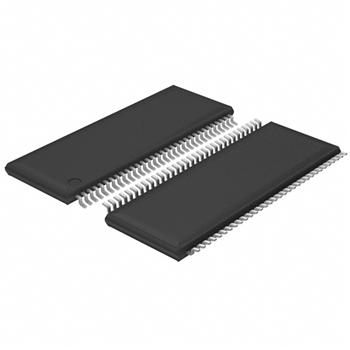
SN74GTLPH1655DGGR 供应商
-
SN74GTLPH1655DGGR
品牌:TI 封装/批号:原厂原装/22+ -
SN74GTLPH1655DGGR
品牌:TI(德州仪器) 封装/批号:TSSOP-64/2022+ -
SN74GTLPH1655DGGR
品牌:TI 封装/批号:TSSOP64/23+ -
SN74GTLPH1655DGGR
品牌:TI 封装/批号:/21+
SN74GTLPH1655DGGR 属性参数
- 标准包装:1
- 类别:集成电路 (IC)
- 家庭:逻辑 - 通用总线函数
- 系列:74GTLPH
- 逻辑类型:通用总线收发器
- 输入数:-
- 电路数:16 位
- 输出电流高,低:24mA,24mA
- 电源电压:3.15 V ~ 3.45 V
- 工作温度:-40°C ~ 85°C
- 安装类型:表面贴装
- 封装/外壳:64-TFSOP (0.240",6.10mm 宽)
- 供应商设备封装:64-TSSOP
- 包装:®
- 其它名称:296-12340-6
产品特性
- Member of Texas Instruments' Widebus™ Family
- UBT™ Transceiver Combines D-Type Latches and D-Type Flip-Flops for Operation in Transparent, Latched, or Clocked Mode
- TI-OPC™ Circuitry Limits Ringing on Unevenly Loaded Backplanes
- OEC™ Circuitry Improves Signal Integrity and Reduces Electromagnetic Interference
- Bidirectional Interface Between GTLP Signal Levels and LVTTL Logic Levels
- Partitioned as Two 8-Bit Transceivers With Individual Latch Timing and Output Control, but With a Common Clock
- LVTTL Interfaces Are 5-V Tolerant
- High-Drive GTLP Outputs (100 mA)
- LVTTL Outputs (\x9624 mA/24 mA)
- Variable Edge-Rate Control (ERC) Input Selects GTLP Rise and Fall Times for Optimal Data-Transfer Rate and Signal Integrity in Distributed Loads
- Ioff, Power-Up 3-State, and BIAS VCC Support Live Insertion
- Bus Hold on A-Port Data Inputs
- Distributed V CC and GND Pins Minimize High-Speed Switching Noise
- Latch-Up Performance Exceeds 100 mA Per JESD 78, Class II
- ESD Protection Exceeds JESD 22 2000-V Human-Body Model (A114-A) 200-V Machine Model (A115-A) 1000-V Charged-Device Model (C101)
- 2000-V Human-Body Model (A114-A)
- 200-V Machine Model (A115-A)
- 1000-V Charged-Device Model (C101)
产品概述
The SN74GTLPH1655 is a high-drive, 16-bit UBT™ transceiver that provides LVTTL-to-GTLP and
GTLP-to-LVTTL signal-level translation. It is partitioned as two 8-bit transceivers and allows for transparent,
latched, and clocked modes of data transfer. The device provides a high-speed interface between cards
operating at LVTTL logic levels and a backplane operating at GTLP signal levels. High-speed (about three times
faster than standard LVTTL or TTL) backplane operation is a direct result of GTLP's reduced output swing
(<1 V), reduced input threshold levels, improved differential input, OEC™ circuitry, and TI-OPc™ circuitry.
Improved GTLP OEC and TI-OPC circuits minimize bus-settling time and have been designed and tested using
several backplane models. The high drive allows incident-wave switching in heavily loaded backplanes with
equivalent load impedance down to 11 .
GTLP is the Texas Instruments (TI™) derivative of the Gunning Transceiver Logic (GTL) JEDEC standard
JESD 8-3. The ac specification of the SN74GTLPH1655 is given only at the preferred higher noise-margin
GTLP, but the user has the flexibility of using this device at either GTL (VTT = 1.2 V and VREF = 0.8 V) or GTLP
(VTT = 1.5 V and VREF = 1 V) signal levels.
Normally, the B port operates at GTLP signal levels. The A-port and control inputs operate at LVTTL logic levels,
but are 5-V tolerant and are compatible with TTL and 5-V CMOS inputs. VREF is the B-port differential input
reference voltage.
This device is fully specified for live-insertion applications using Ioff, power-up 3-state, and BIAS VCC. The Ioff
circuitry disables the outputs, preventing damaging current backflow through the device when it is powered
down. The power-up 3-state circuitry places the outputs in the high-impedance state during power up and power
down, which prevents driver conflict. The BIAS VCC circuitry precharges and preconditions the B-port
input/output connections, preventing disturbance of active data on the backplane during card insertion or
removal, and permits true live-insertion capability.
This GTLP device features TI-OPC circuitry, which actively limits overshoot caused by improperly terminated
backplanes, unevenly distributed cards, or empty slots during low-to-high signal transitions. This improves
signal integrity, which allows adequate noise margin to be maintained at higher frequencies.
High-drive GTLP backplane interface devices feature adjustable edge-rate control (ERC). Changing the ERC
input voltage between GND and VCC adjusts the B-port output rise and fall times.This allows the designer to
optimize system data-transfer rate and signal integrity to the backplane load.
Active bus-hold circuitry holds unused or undriven LVTTL data inputs at a valid logic state. Use of pullup or
pulldown resistors with the bus-hold circuitry is not recommended.
When VCC is between 0 and 1.5 V, the device is in the high-impedance state during power up or power down.
However, to ensure the high-impedance state above 1.5 V, the output-enable (OE\) input should be tied to VCC
through a pullup resistor; the minimum value of the resistor is determined by the current-sinking capability of
the driver.
 SN74GTLPH1655DGGR