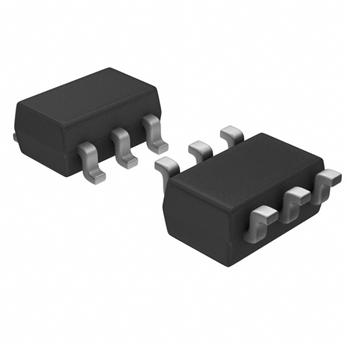
CLVC1G374QDBVRQ1 供应商
-
CLVC1G374QDBVRQ1
品牌:TI 封装/批号:原厂原装/22+ -
CLVC1G374QDBVRQ1
品牌:TI 封装/批号:原厂原封装/新批号 -
CLVC1G374QDBVRQ1
品牌:TI 封装/批号:TSSOP/23+
CLVC1G374QDBVRQ1 属性参数
- 标准包装:1
- 类别:集成电路 (IC)
- 家庭:逻辑 - 触发器
- 系列:74LVC
- 功能:标准
- 类型:D 型
- 输出类型:三态非反相
- 元件数:1
- 每个元件的位元数:1
- 频率 - 时钟:175MHz
- 延迟时间 - 传输:1ns
- 触发器类型:正边沿
- 输出电流高,低:40mA,40mA
- 电源电压:1.65 V ~ 5.5 V
- 工作温度:-40°C ~ 125°C
- 安装类型:表面贴装
- 封装/外壳:SOT-23-6
- 包装:®
- 其它名称:296-29570-6
产品特性
- Qualified for Automotive Applications
- Supports 5-V VCC Operation
- Inputs Accept Voltages to 5.5 V
- Max tpd of 4 ns at 3.3 V
- Low Power Consumption, 10-µA Max ICC
- ±24-mA Output Drive at 3.3 V
- Ioff Supports Partial-Power-Down Mode Operation
- Latch-Up Performance Exceeds 100 mA Per JESD 78, Class II
- ESD Protection Exceeds JESD 22 2000-V Human-Body Model (A114-A) 200-V Machine Model (A115-A) 1000-V Charged-Device Model (C101)
- 2000-V Human-Body Model (A114-A)
- 200-V Machine Model (A115-A)
- 1000-V Charged-Device Model (C101)
产品概述
This single D-type flip-flop is designed for 1.65-V to 5.5-V VCC
operation.The SN74LVC1G374 features a 3-state output designed specifically for driving highly
capacitive or relatively low-impedance loads. This device is particularly suitable for implementing
buffer registers, input/output (I/O) ports, bidirectional bus drivers, and working
registers.On the positive transition of the clock (CLK) input, the Q output is set to the logic
level set up at the data (D) input.A buffered output-enable (OE) input can be used to place the
output in either a normal logic state (high or low logic levels) or the high-impedance state. In
the high-impedance state, the output neither loads nor drives the bus lines significantly. The
high-impedance state and increased drive provide the capability to drive bus lines without
interface or pullup components.OE does not affect the internal operations of the flip-flop. Old
data can be retained or new data can be entered while the outputs are in the high-impedance
state.To ensure the high-impedance state during power up or power down,
OE should be tied to VCC through a pullup resistor;
the minimum value of the resistor is determined by the current-sinking capability of the
driver.To ensure the high-impedance state during power up or power down,
OE should be tied to VCC through a pullup resistor;
the minimum value of the resistor is determined by the current-sinking capability of the
driver.This device is fully specified for partial-power-down applications using
Ioff. The Ioff circuitry disables the outputs,
preventing damaging current backflow through the device when it is powered down.
 CLVC1G374QDBVRQ1