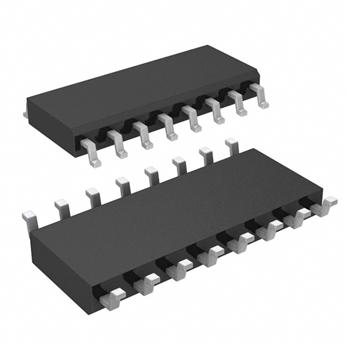
CD74HCT4316M96 供应商
-
CD74HCT4316M96
品牌:TI 封装/批号:原厂原装/22+ -
CD74HCT4316M96
品牌:TI/德州仪器 封装/批号:SOP16/21+ -
CD74HCT4316M96
品牌:TI(德州仪器) 封装/批号:SOIC-16/2022+
CD74HCT4316M96 属性参数
- 标准包装:2,500
- 类别:集成电路 (IC)
- 家庭:接口 - 模拟开关,多路复用器,多路分解器
- 系列:74HCT
- 功能:开关
- 电路:4 x SPST - NO
- 导通状态电阻:170 欧姆
- 电压电源:单/双电源
- 电压 - 电源,单路/双路(±):4.5 V ~ 5.5 V,±1 V ~ 5 V
- 电流 - 电源:-
- 工作温度:-55°C ~ 125°C
- 安装类型:表面贴装
- 封装/外壳:16-SOIC(0.154",3.90mm 宽)
- 供应商设备封装:16-SOIC N
- 包装:带卷 (TR)
产品特性
- Wide Analog-Input-Voltage Range VCC – VEE...0V to 10V
- Low "ON" Resistance 45 (Typ)...VCC = 4.5V 35 (Typ)...VCC = 6V 30 (Typ)...VCC – VEE = 9V
- 45 (Typ)...VCC = 4.5V
- 35 (Typ)...VCC = 6V
- 30 (Typ)...VCC – VEE = 9V
- Fast Switching and Propagation Delay Times
- Low "OFF" Leakage Current
- Built-In "Break-Before-Make" Switching
- Logic-Level Translation to Enable 5V Logic to Accommodate ±5V Analog Signals
- Wide Operating Temperature Range . . . –55°C to 125°C
- HC Types 2V to 10V Operation High Noise Immunity: NIL = 30%, NIH = 30% of VCC at VCC = 5V
- 2V to 10V Operation
- High Noise Immunity: NIL = 30%, NIH = 30% of VCC at VCC = 5V
- HCT Types Direct LSTTL Input Logic Compatibility, VIL = 0.8V (Max), VIH = 2V (Min) CMOS Input Compatibility, Il 1µA at VOL, VOH
- Direct LSTTL Input Logic Compatibility, VIL = 0.8V (Max), VIH = 2V (Min)
- CMOS Input Compatibility, Il 1µA at VOL, VOH
产品概述
The ’HC4316 and CD74HCT4316 contain four independent digitally controlled analog switches that use silicon-gate CMOS technology to achieve operating speeds similar to LSTTL with the low power consumption of standard CMOS integrated circuits.In addition these devices contain logic-level translation circuits that provide for analog signal switching of voltages between ±5V via 5V logic. Each switch is turned on by a high-level voltage on its select input (S) when the common Enable (E) is Low. A High E disables all switches. The digital inputs can swing between VCC and GND; the analog inputs/outputs can swing between VCC as a positive limit and VEE as a negative limit. Voltage ranges are shown in Figures 2 and 3.
 CD74HCT4316M96